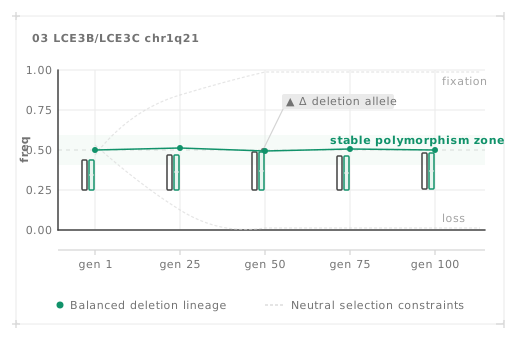
Skin directly interacts with the environment at multiple levels and so evolves under various adaptive forces: it is the first barrier against pathogens and external agents and helps regulate body temperature. We argue that structural variants likely have a stronger functional impact than single-nucleotide variants because of their size.
In a study I led, we found that a common 32 kb deletion of the LCE3B and LCE3C genes — associated with psoriasis — is ancient, predating the Human–Denisovan divergence. Yet it was unclear why negative selection had not removed it. We showed that the haplotype block harboring the deletion (i) retains high allele frequency among extant and ancient human populations; (ii) harbors unusually high nucleotide variation; (iii) contains an excess of intermediate-frequency variants; and (iv) has an unusually long time to coalescence to the most recent common ancestor.
Our results are most parsimonious with the LCE3BC deletion having evolved under balancing selection in humans — consistent with the hypothesis that a balance between autoimmunity and “natural vaccination” through increased pathogen exposure maintains the deletion. I led the bioinformatic interrogation of variation at this locus in modern and ancient human populations, and contributed the theoretical link between autoimmunity and natural vaccination.
Key findings
Why it matters
Many variants that raise disease risk remain common in human populations — a paradox. Showing that an autoimmune-linked skin-gene deletion is held in place by balancing selection supports the idea that the same variant offsets its cost with a benefit, such as stronger pathogen defense.
Key terms
- Structural variant
- A large change to the genome (deletion, duplication, inversion) — often more impactful than a single-letter change.
- Balancing selection
- Selection that keeps multiple variants in a population, e.g. when a variant carries both a cost and a benefit.
- Haplotype
- A set of DNA variants inherited together on the same chromosome.
Collaborators
Explore other research