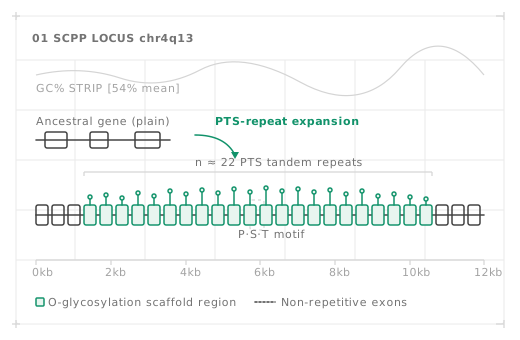
Mucin proteins are highly glycosylated molecules critical for mucus generation, cellular signaling, and microbial interactions on epithelial surfaces. Functionally, mucins share proline-, serine-, and threonine-rich (PTS) repeats that serve as O-glycosylation sites. However, unlike several other homologous gene families, several mucin subfamilies have evolved independently, and the mechanisms through which they evolved remain mostly unknown.
In this ongoing study we performed a genome-wide analysis to find how conserved mucins are across mammalian species. We identified that the secretory calcium-binding phosphoprotein (SCPP) gene locus is a hotspot for de novo mucin evolution in mammals. Further bioinformatic analysis of this locus documented 27 hitherto undescribed mucins, highlighting 15 instances of independent mucin evolution. We confirmed the expression of a subset of these mucins in saliva using gel electrophoresis and subsequent mass-spectrometric analysis.
We constructed a plausible model arguing that the secretory and proline-rich nature of proteins encoded by genes in the SCPP locus provides fodder for recurrent mucinization. These results have broad implications for understanding the evolution of gene families coding for O-glycosylated, secreted, multiple-repeat-domain proteins.
Key findings
Why it matters
Mucins coat every wet surface of the body and are central to defense, signaling, and disease — yet how new ones arise was largely unknown. Showing that one gene locus repeatedly "mucinizes" reveals a general route for how brand-new biological functions can evolve.
Key terms
- Mucin
- A heavily sugar-coated (glycosylated) protein that gives mucus its slippery, protective properties.
- O-glycosylation
- The attachment of sugar chains to serine/threonine residues of a protein — dense on mucins.
- PTS repeats
- Proline-, serine-, and threonine-rich repeated sequence that serves as the scaffold for mucin glycosylation.
- SCPP locus
- The secretory calcium-binding phosphoprotein gene region — here shown to repeatedly spawn new mucins.
Collaborators
Explore other research