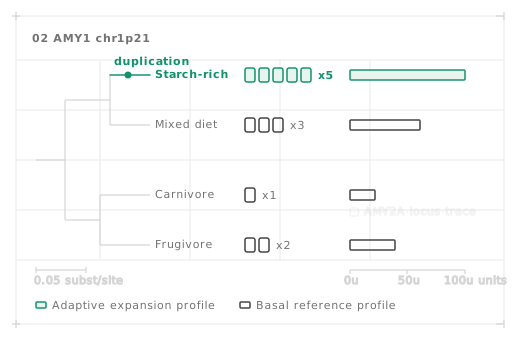
Saliva is the first stop for food, microorganisms, and other xenobiotic molecules entering our bodies. It regulates microbial composition, helps with predigestion and taste perception, and maintains the overall homeostasis of the oral cavity. This direct environmental interaction makes saliva an ideal candidate for evolutionary pressures. An illustrative example is the amylase gene (AMY), which encodes a starch-digesting enzyme in animals; previous studies found that AMY underwent several copy-number gains in humans, dogs, and mice, possibly alongside increased starch consumption.
In this study, we present comprehensive evidence for AMY copy-number expansions that independently occurred in several mammalian species consuming starch-rich diets. We also provide correlative evidence that AMY gene duplications may be an essential first step for amylase to be expressed in saliva. Our findings underscore the importance of gene copy-number amplification as a flexible, fast evolutionary mechanism that can independently arise in different branches of the phylogeny.
I led the collaborative effort to collect mammalian DNA and saliva samples from across the globe — including wolves, African pouched rats, wild boars, and non-human primates — and deduced that the likely mechanism for independent AMY duplication was through retrotransposon events. The project connected my training in bioinformatics to wet-lab work measuring enzymatic activity in saliva, letting me take it full circle.
Key findings
Why it matters
Saliva is the first contact point for food and microbes, which makes it a sensitive recorder of evolutionary pressure. Showing that starch-rich diets repeatedly drove amylase gene duplication links what species eat to how their genomes are structured.
Key terms
- Amylase (AMY)
- The enzyme that begins digesting starch; its gene copy number varies with diet across species.
- Copy-number variation
- Differences between individuals or species in how many copies of a gene they carry.
- Retrotransposon
- A mobile genetic element that copies itself via RNA — here implicated in duplicating the amylase gene.
Collaborators
Explore other research