Abstract
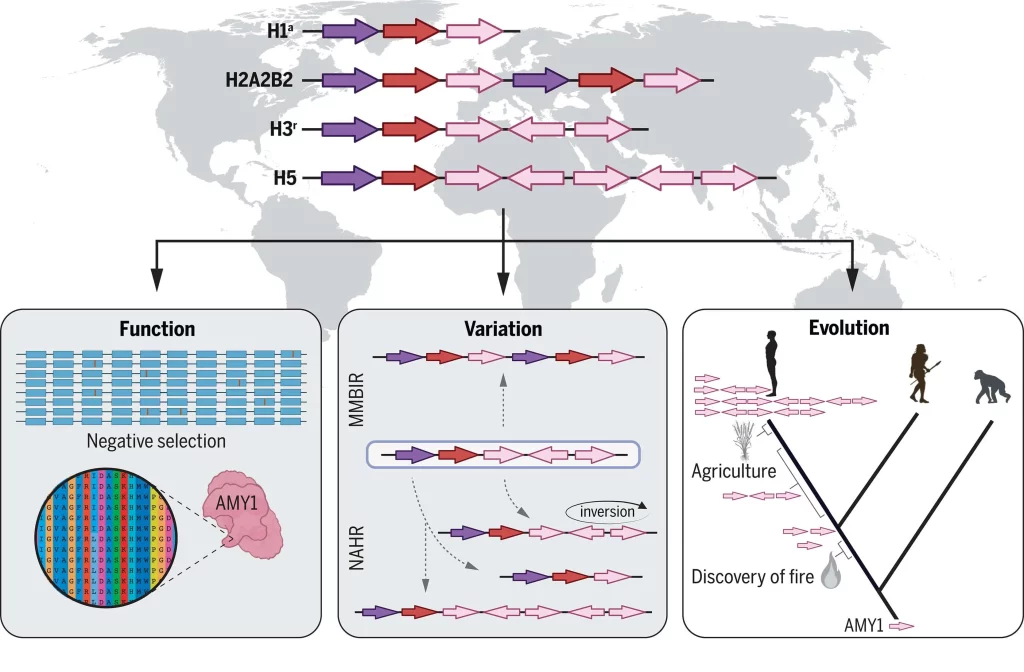
Human adaptation to a wide range of diets is a hallmark of our species, sometimes even reflected in our genomic diversity. The amylase gene encodes an enzyme that digests starch, a complex carbohydrate found in many modern human diets. Genomic studies have found substantial variation in the number of amylase gene copies, believed to be an adaptive response to dietary changes among human populations after the advent of agriculture. We reconstruct the locus's evolutionary history, tracing duplications that predate agriculture and seeded modern structural variation.
Human adaptation to a wide range of diets is a hallmark of our species, sometimes even reflected in our genomic diversity. The amylase gene encodes an enzyme that digests starch, a complex carbohydrate found in many modern human diets. Genomic studies have found substantial variation in the number of amylase gene copies, which is believed to be an adaptive response to dietary changes among human populations, after the advent of agriculture.
Using long-read sequencing and pangenome resources, we reconstruct the structural history of the human amylase locus, identifying ancient duplication events that predate the divergence of modern humans, Neanderthals, and Denisovans. These ancient duplications appear to have “seeded” the locus for the rapid, recent structural diversification observed in present-day human populations, providing a mechanistic link between deep evolutionary history and contemporary genomic variation tied to starch digestion.