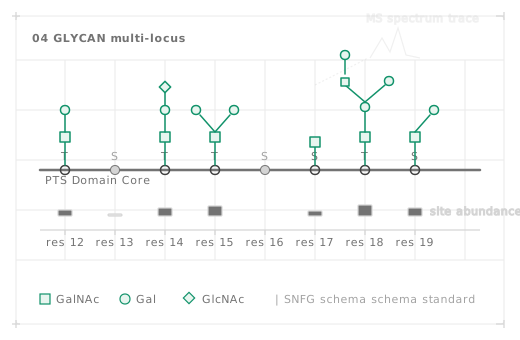
Placeholder — content in progress. This is the newest direction of my work: an NSF Postdoctoral Fellowship in Dr. Stacy Malaker’s lab at Yale University, where I’m gaining expertise in glycoproteomics — the study of the sugar chains (glycans) attached to proteins and how they shape function and disease.
Glycoproteomics complements my evolutionary-genetics background: where my earlier work traced how sugar-coated proteins such as mucins arise and diversify across species, this direction focuses on what those sugars do — mapping glycans on proteins by mass spectrometry to connect molecular structure to biological function and clinical relevance.
Key findings
Why it matters
The sugars on proteins are central to how cells communicate and how diseases like cancer progress, yet they are hard to measure. Building glycoproteomics expertise lets me connect the evolutionary genetics of sugar-coated proteins (like mucins) to their function and clinical relevance.
Key terms
- Glycoproteomics
- The large-scale study of glycoproteins — proteins decorated with sugar chains (glycans) — and how those sugars change function.
- Glycan
- A chain of sugar molecules attached to a protein or lipid; glycans tune protein behavior, signaling, and immune recognition.
- Mass spectrometry
- A technique that identifies and measures molecules by mass — the workhorse for mapping glycans on proteins.
Collaborators
Explore other research