I’m thrilled to share that I’ve been awarded a prestigious Postdoctoral Research Fellowship in Biology (PRFB) from the National Science Foundation! This incredible opportunity allows me to join Dr. Stacy Malaker’s lab at Yale University, where I’ll dive deeper into the fascinating world of glycoproteomics and continue exploring the evolutionary genetics of mucins.
You can read the full UBNOW interview with me at this link:
→ UB alumnus awarded NSF fellowship to study evolution of mucus and its role in pregnancy
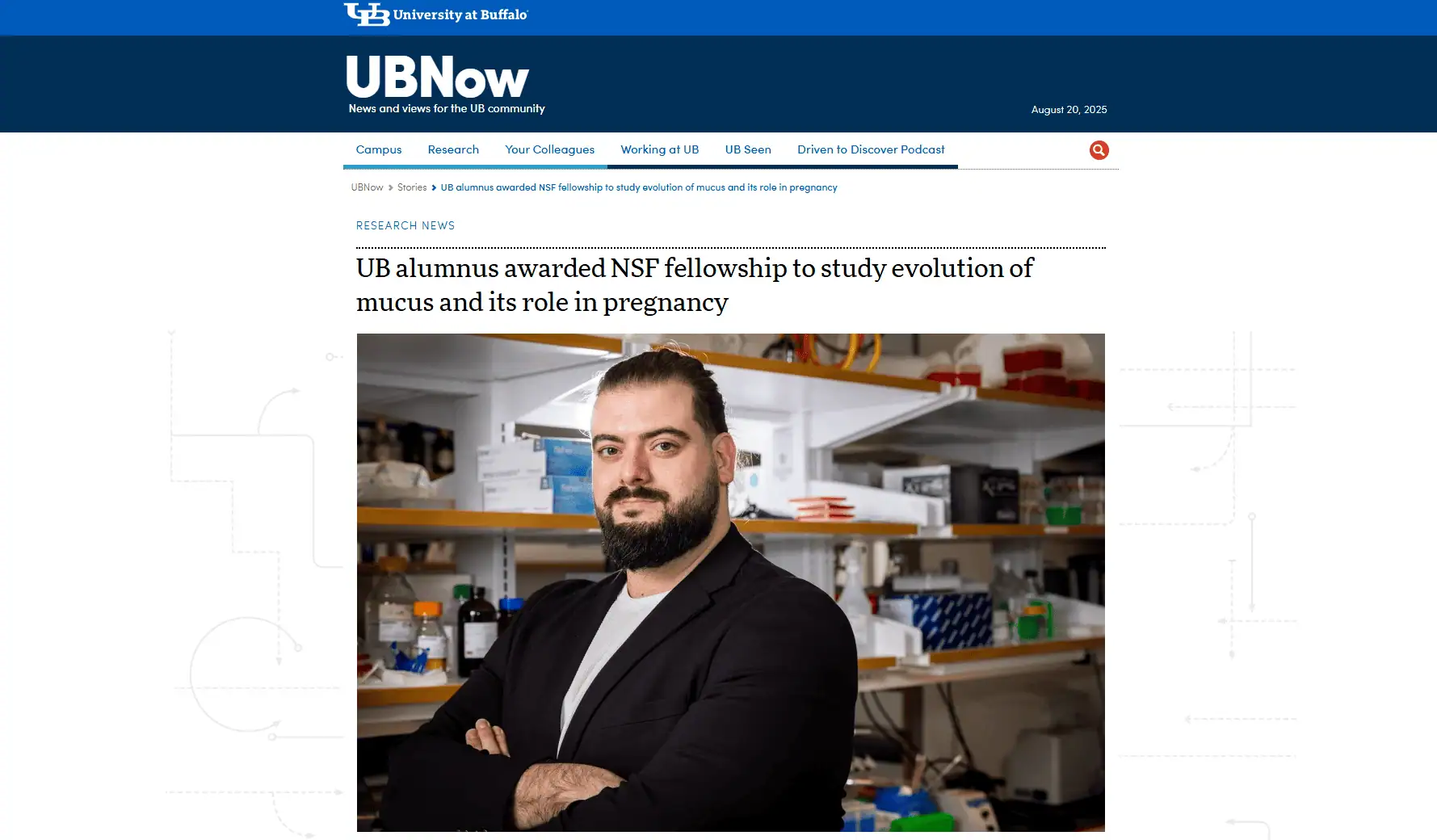
UB alumnus awarded NSF fellowship to study evolution of mucus and its role in pregnancy
Full article repritned with UBNow’s permission:
By TOM DINKI
Published July 10, 2025
Petar Pajic, a first-generation American and Lackawanna native who recently earned his PhD in evolutionary genetics from UB, has received a postdoctoral fellowship from the National Science Foundation (NSF).
Pajic will carry out the three-year, Postdoctoral Research Fellowship in Biology (PRFB), one of only approximately 30 awarded nationwide, at Yale University. Earlier this month, he joined the lab of Stacy Malaker, Yale assistant professor of chemistry and a leader in developing cutting-edge methods to analyze mucins, the heavy glycosylated proteins that form mucus and are implicated in many diseases.
“I’m honored to receive a fellowship of this magnitude. It’s incredibly meaningful to have support for the basic science questions that I’m passionate about,” Pajic says. “Looking ahead, I’m excited to push the boundaries of what we know in evolutionary genetics and integrate this with glycoproteomics in order to carve out a unique research niche.
“Hopefully in the future, I can establish my own laboratory that advances our understanding of how complex genetic variation shapes human biology.”
Born in Lackawanna, just south of Buffalo, Pajic’s parents came to the U.S. as refugees from Serbian Krajina during the Balkan Wars of the 1990s.
He originally planned to attend medical school but decided to pursue a PhD instead after conducting research with Omer Gokcumen, professor in the UB Department of Biological Sciences. Pajic completed his doctoral research in Gokcumen’s lab.
“Petar is a take-the-bull-by-the-horns kind of student,” Gokcumen says. He never shies away from challenging questions. Such audacity made it possible for him to build on his recent discoveries and integrate two really exciting fields of science.”
Pajic’s work centers around structural variants, large-scale genetic changes common in human genomes, and how they drive both functional innovation and disease risk. He’s particularly interested in evolutionary trade-offs, where mutations that provide advantages in one context may be detrimental in another.
Mucins provide a compelling model for these questions. These genes encode proteins that contain repetitive sequences covered in sugars that give mucus its slippery, protective properties on the surfaces of organs.
Pajic found that mucin repeats can evolve from within non-mucin genes, transforming it into a mucin, offering a new model for how novel gene functions can evolve.
His dissertation, “Mucins provide insights into mechanisms of functional evolution,” was selected as UB’s sole nomination to compete nationally for the Council of Graduate Schools/ProQuest Distinguished Dissertation Award.
Altogether, Pajic has been an author on seven published studies, with three additional publications on the way, and he has mentored more than 10 students.
He has been involved in several medical internships, as well as conducted research with Stefan Ruhl, professor and chair of the UB Department of Oral Biology, School of Dental Medicine.
“I believe this gives me a well-rounded background necessary for coupling health and genetics,” Pajic says.
At Yale, he will focus on the MUC1 gene, an extremely size-variable mucin critical to pregnancy. His work will apply state-of-the-art glycoproteomic tools to better understand how repeat variation affects the bonded sugar structures and mucus barrier function in the uterus.
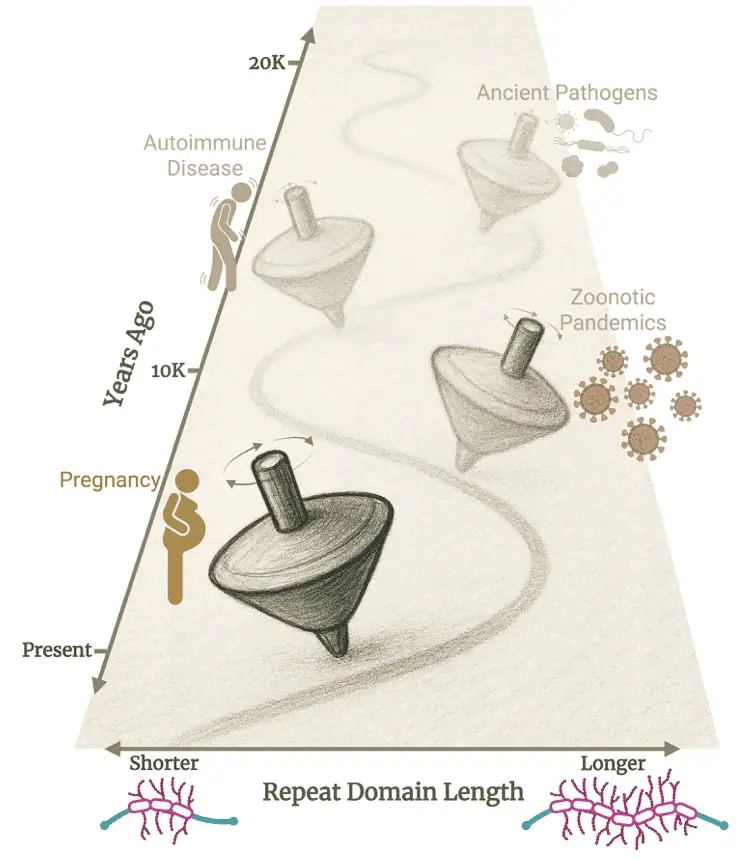
“More broadly, I’m exploring the idea that, over the course of human evolution, constant exposure to pathogens, especially during major pandemics, may have driven mucins like MUC1 to grow longer as a way to help shield our organs,” Pajic explains. “However, this evolutionary advantage may also come with trade-offs in modern environments, potentially contributing to mucosal diseases, cancers or even influencing pregnancy outcomes.”